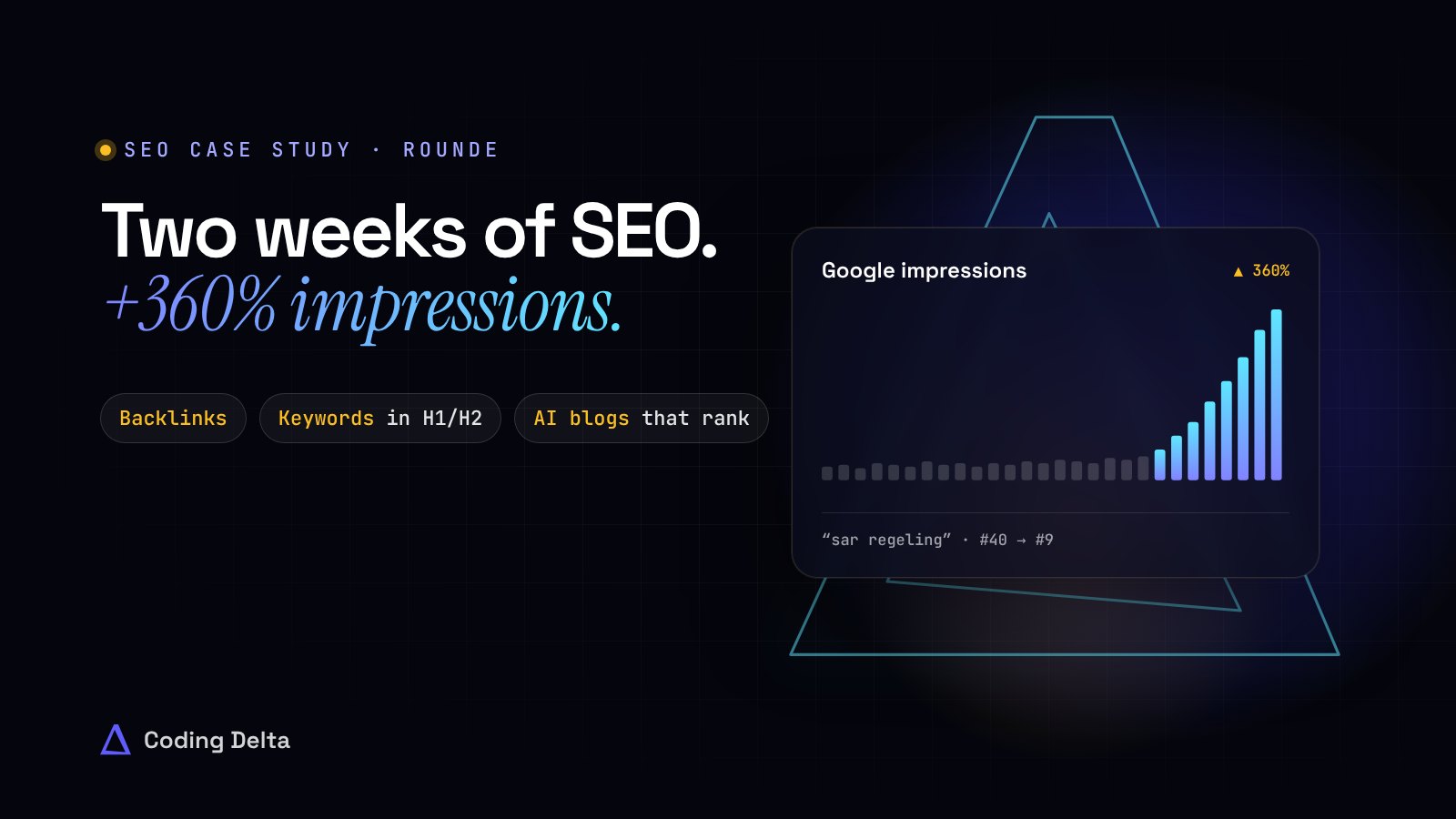
For a long time, RoundE got steady but unspectacular traffic from Google. Then we spent two weeks on the SEO basics we had neglected: backlinks, keywords, and a better way to write blog posts with ChatGPT. Our Google impressions shot up. Here is exactly what we did, so you can do it yourself.
TL;DR
- Backlinks: find out where your competitors get their links with Ahrefs' free backlink checker, and ask those sites to add you too.
- Keywords: put the terms people actually search for in your H1 and H2 tags. For "SAR regeling", we moved from position 40 to position 9 in Google within two weeks.
- Blogs: have GPT write articles one paragraph at a time from an outline, edit them by hand, and get them indexed within hours instead of weeks.
Background: what RoundE does
A couple of years ago, we started RoundE.nl, StakOprichten.nl and StockAppreciationRights.nl. RoundE helps companies set up employee participation plans, such as share plans, option plans and stock appreciation rights.
The idea is to let employees share in the upside of the business, so they become more involved.
There is plenty of information online about participation plans, but no website really guided companies to the best solution for them. So we created:
- In-depth content about each plan.
- A comprehensive questionnaire (survey) that guides companies to a plan that might suit them.

Visitors came in steadily and clients found us more easily, but it wasn't anything major, as this Google Search Console chart shows.

How we improved our SEO
Two weeks before we wrote this post, we decided to work on our SEO. We had always focused on great content, but not on making that content easy for Google to discover.
We improved three things:
- Backlinks
- Keywords
- Blogs
1. Backlinks
We didn't have strong backlinks. We added some from other sites we own, but those sites are outside RoundE's niche. We needed more high-quality backlinks.
Here is what we did:
- We used Ahrefs' free backlink checker (https://ahrefs.com/backlink-checker) to find out where our competitors get their backlinks.
- We emailed those site owners and asked whether they could add us to their page as well.
Some refused, but others added us right away, which improved our domain authority score.
The value goes beyond the link itself: our link now sits on the same page as our competitors. That makes it easier for Google to associate us with our niche.
To strengthen this further, we wrote a blog post comparing all the players in the market, with links to their pages. Yes, visitors can click through to our competitors, but it also tells Google that we belong in the same niche.
2. Keywords
Our content was good, but it didn't use the words people type into Google. We fixed that in two ways.
Use your market's main keywords on your homepage. Our homepage didn't mention "medewerkersparticipatie" or "werknemersparticipatie" (Dutch for employee participation), even though those are the two most important keywords in our market. We added them to the H1 and H2 tags on our homepage and other pages.
Optimize each product page for its own search term. Next, we looked at the SEO for the specific plans we offer. When you type "SAR" into Google, the first suggestions are about currencies, but the third is "SAR regeling". So that is apparently what people search for.

In Google Ads (https://ads.google.com/) you can see how many monthly searches a keyword gets. "SAR regeling" gets up to 1,000 searches a month (the 100–1K range below), which is quite high in our niche. So we added it to the H1 and H2 tags on that page. Within two weeks, we went from position 40 to position 9 in Google for that keyword.

3. Blogs
We had experimented with writing blogs with ChatGPT before, but the results were never great. The articles were superficial, lacked depth and didn't help visitors.
So we experimented. Instead of asking ChatGPT for a full article, we first asked it for an outline. Once we were happy with the outline, we asked it to write the article based on that outline. The posts got considerably better, but we could do better still.
We wrote a simple script that works like this:
- Generate an outline based on our keyword.
- Ask GPT to write a single paragraph for the first item in the outline.
- Give GPT its previous paragraph and ask it to write the next one, following the outline. Repeat until the article is done.
The result: long paragraphs with in-depth information. The articles aren't perfect and still need some manual editing, including adding links to other pages on our site. But it saves us more than 95% of the time compared to writing articles from scratch.
Getting indexed faster
Normally, you wait a couple of days or weeks before Google indexes your pages. We use the Google Indexing Script instead. It sends all your URLs to Google's Indexing API, and our links get indexed within hours.
The first results are promising: we can quickly write articles tailored to niche keywords and rank well for them.
Next steps
Our impressions in Google have skyrocketed, but clicks haven't grown as fast. That is our next focus.
Setting up a participation plan, or growing a platform of your own?
If you're a startup that wants to give employees a stake in the business through shares, options, STAK certificates or SARs, RoundE helps you find and set up the right plan.
RoundE is one of the products we build and run ourselves at Coding Delta, a boutique software studio in Amsterdam. We also build web platforms, apps, and AI and automation for clients. Want to discuss your idea? Use the button below to get in touch.
Curious what this could do for you?
We're happy to think along — over coffee on the Keizersgracht or on a video call.